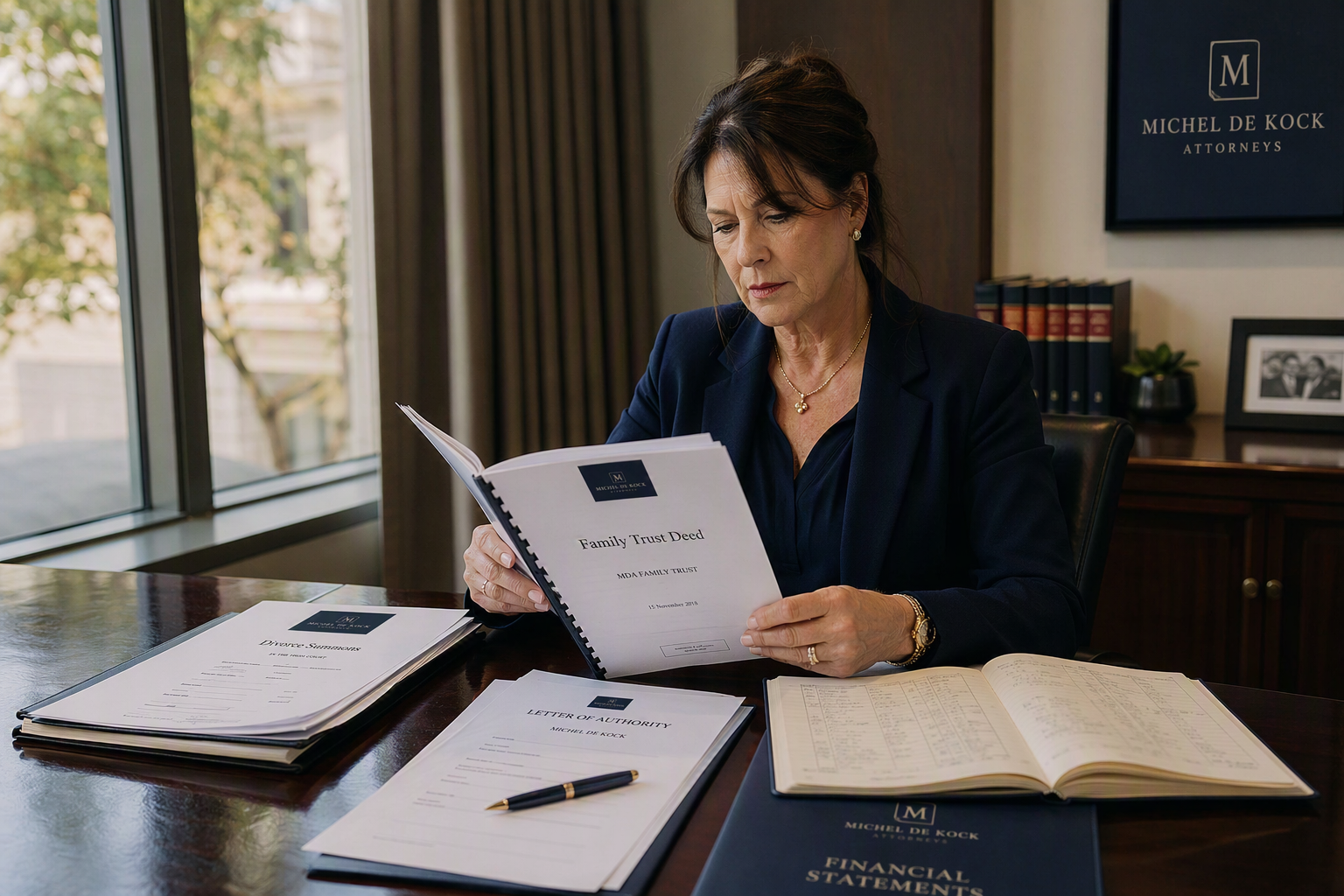
You have started, or are about to start, a divorce. You know that most of the wealth built up during the marriage is held in a family trust. The house, the business, the investment portfolio, the holiday property, the vehicles. On paper, your spouse says none of it belongs to them. It all belongs to the trust. The summons has been issued citing only the two of you. Settlement talks stall the moment trust assets are raised, because the trustees say they are not before court and cannot be bound.
This article explains joining a trust to a divorce as a procedural step, when it is necessary, how it is done under Uniform Rule 10, and what relief it can and cannot unlock. It is written for divorcing spouses and their advising attorneys who need to understand why citing the trustees is often the difference between a settlement that holds and a paper victory that cannot be enforced.
Why a Family Trust Often Becomes the Real Battleground in a South African Divorce
In many high-asset South African marriages, the family trust is not a side issue. It is the main structure through which assets are acquired, held and controlled. Property is registered in the name of the trust. Business interests sit inside the trust. Investment portfolios are held by the trust. The family lives in a home the trust owns.
When the marriage ends, the reader who is not the trustee spouse suddenly discovers that everything they thought of as jointly built has been placed one step removed from the estate that the divorce court will actually divide. That is where a family trust in a divorce turns from a background arrangement into the central dispute.
The problem is not that a trust is unlawful. Trusts are a legitimate and common wealth-holding structure. The problem is that the way the trust has been operated may not match the way it is described on paper. A discretionary inter vivos trust that is run in practice as one spouse’s private wallet is treated very differently, in law, from a trust that is genuinely administered by independent trustees who exercise real judgment.
The reader’s practical question is not whether the trust exists. It is whether the trust and its trustees must be brought before the divorce court so that the court can consider what has really happened, and so that any order the court makes can be enforced.
Joining a Trust to a Divorce Is Not the Same as Piercing It: Three Routes Explained
One of the most common mistakes clients make is treating joinder, going behind the trust form, and a sham declaration as if they were the same argument. They are not. Each route has its own purpose, its own evidence base, and its own remedy. Understanding the distinction is the starting point for any strategy involving piercing a trust in divorce proceedings.
Route 1 — Joinder Under Uniform Rule 10
Joinder is procedural. It answers the question: who must be before the court? Uniform Rule 10 of the Uniform Rules of Court allows parties with a direct and substantial interest in the subject matter of the litigation to be joined. Where the divorce court is asked to make an order that affects trust property, trust administration, trustee duties, or the enforceability of relief against the trust, the trustees must usually be cited in their official capacities. This is what places the trust as party to divorce proceedings, through the trustees who administer it.
Joining trustees does not mean the court has decided that the trust is one spouse’s alter ego. It does not mean trust assets automatically become matrimonial property. It means the trustees are properly before the court, they have the opportunity to answer the allegations, and any order the court makes will bind them.
Route 2 — Going Behind the Trust Form (Badenhorst, REM v VM, MJK v IIK)
The second route is substantive. Badenhorst v Badenhorst 2006 (2) SA 255 (SCA) established that trust assets may be taken into account for purposes of a redistribution order under section 7(3) of the Divorce Act 70 of 1979 where a spouse exercises de facto control over the trust and, but for the trust, the assets would have formed part of that spouse’s estate. The court emphasised that such control may be evidenced by the manner in which the spouse treated the trust assets as their own,
The Supreme Court of Appeal confirmed in REM v VM 2017 (3) SA 371 (SCA) that trust assets can also be relevant to an accrual claim under the Matrimonial Property Act 88 of 1984 particularly where the trust has been misused to evade or frustrate the proper calculation of the accrual.
More recently, MJK and Others v IIK 2023 (2) SA 158 (SCA) emphasised the importance of how the case is pleaded and proved. Allegations of control must be supported by specific factual averments and it is insufficient to rely on conclusory statements such as that the trust is an alter ego.
None of these cases give a divorcing spouse a free hand over trust assets. The court conducts a fact-specific enquiry into who controlled the trust, how it was used, and whether the structure was used to prejudice the other spouse’s matrimonial claim. Badenhorst and trust assets in divorce is an argument about value attribution, not about ownership. For the conceptual background to this line of authority, see our note on how a trust veneer can affect your divorce settlement.
Route 3 — Declaring the Trust a Sham (Van Zyl NNO v Kaye NO)
The third route goes to the validity of the trust itself. A sham argument says the trust was never genuinely intended to operate as a trust. Van Zyl NNO v Kaye NO 2014 (4) SA 452 (WCC) is a useful authority because it warns against loosely labelling every abused or poorly administered trust as a sham. A badly administered trust is not automatically invalid. The evidential burden for a sham declaration is high, and the allegation should not be raised casually.
The three routes are cumulative in the sense that a party may plead in the alternative, but they require different pleadings, different evidence, and different relief.
Concerned that a family trust is being used to ring-fence matrimonial assets?
Book a contested divorce consultation with Chanté Mouton to review the trust deed, the trustees’ conduct, and whether joinder should be raised before settlement is signed.
How and When to Cite the Trust and Trustees Under Uniform Rule 10
The safer practice is to cite the trustees nomine officio, meaning in their official capacities as trustees of the named trust. The trust deed and the letters of authority issued by the Master of the High Court identify who those trustees are. Where the trust registration number is known, it should be included.
A trust is not a juristic person in the same way as a company. It cannot sue or be sued in its own name in the ordinary sense. The trustees administer the trust estate, and it is the trustees who are the proper parties to litigation affecting the trust.
Beneficiaries do not automatically have to be joined. In a discretionary trust, beneficiaries usually do not have vested rights in trust assets merely because they are named in the trust deed. Where the relief sought will affect vested rights, beneficiaries may need to be joined, but that is a fact-sensitive question that has to be answered on the pleadings and the trust deed.
The procedural path depends on the stage of the divorce.
- When the summons is issued. The cleanest position is to cite the trustees from the outset. If the trust is already known to be central to the matrimonial estate, that is the moment to cite trustees in divorce proceedings, not later.
- Before pleadings close. The particulars of claim or counterclaim can usually be amended to cite the trustees and set out the relief and the facts relied upon.
- After pleadings close. A formal amendment may still be possible, but if it is opposed, a substantive application for leave to amend may be required.
- Where joinder is disputed. A separate joinder application under Rule 10 may be necessary. The founding affidavit must explain why the trustees have a direct and substantial interest and why the divorce cannot properly be decided without them.
Timing matters. Trust disputes are document heavy. If joinder is left until shortly before trial, the matter may be postponed, costs may be wasted, and the trust may not be properly dealt with in discovery, expert reports, or settlement negotiations.
Where one trustee is non-resident or refuses to participate, the pleadings and service arrangements must be adapted. That does not defeat joinder, but it does require careful handling and, where relevant, service in accordance with the Rules for foreign parties.
What Relief the Court Can and Cannot Order Against the Trustees
The relief a divorce court can grant against joined trustees is not open-ended. Understanding the limits early prevents unrealistic expectations later.
Where joinder is properly effected and the facts justify it, the court may consider the value of trust assets when calculating an accrual claim under the Matrimonial Property Act 88 of 1984, or when exercising its redistribution power under section 7(3) of the Divorce Act 70 of 1979. In line with Badenhorst and trust assets in divorce, this is a value-attribution enquiry that ordinarily results in the trustee spouse being ordered to pay an amount referable to the trust assets.
In appropriate cases, the court can also make orders affecting the administration of the trust, including interdictory relief and, in serious cases, the removal of a trustee under the Trust Property Control Act 57 of 1988. The threshold for removal is high, and the facts must justify it. These are areas where our trusts litigation practice frequently intersects with our divorce work.
What the court will generally not do is freely rewrite the trust deed in the divorce action, or treat trust assets as if they were the personal property of one spouse without conducting the fact-specific enquiry required by the case law. A trustee spouse in a divorce does not lose the protections of the trust deed simply because divorce has been issued. The court still asks how the trust was created, controlled, administered and used.
If the trustees are not joined and the court later makes an order that purports to affect trust property, the practical position becomes difficult. Trustees may argue that they were not parties, did not have the opportunity to be heard, and are not bound by the order. That is a real enforcement risk where the order requires transfer of a property, payment from a trust bank account, disclosure of trust records, or any change to how the trust is administered.
Evidence: Documents to Preserve Before You Move
A joinder application, an accrual argument that relies on trust assets, or an alter-ego pleading all stand or fall on the paper trail. The reader should preserve and, where possible, obtain the following before pleadings are amended or an application is launched.
- The trust deed and all amendments.
- The letters of authority.
- Trustee resolutions and minutes of trustee meetings.
- Annual financial statements and management accounts.
- Loan account schedules between the trust and the spouses.
- Donation agreements and sale agreements moving assets into the trust.
- Property records and vehicle registration documents.
- Bank statements and bank signing mandates.
- Records of who pays trust expenses and who uses trust property.
- Beneficiary distribution records.
- Correspondence with accountants, auditors, banks and financial advisers.
The point of the paper trail is not only to prove that the trust owns assets. It is to prove how the trust was actually operated. Financial disclosure affidavits play an important role here, and readers who want to understand that evidence base should read our note on financial disclosure affidavits in divorce.
Preparing to preserve trust records or amend pleadings? Contact Vermeulen Attorneys to plan the evidence base before the other side has notice.
Red Flags That a Trustee Spouse Is Treating the Trust as an Alter Ego
Certain patterns tend to indicate that a trustee spouse in a divorce has been running the trust as a personal vehicle rather than a properly administered trust. They should be pleaded as facts, not as conclusions.
- Decisions are taken by one trustee without proper meetings or with resolutions signed after the fact.
- The same spouse is founder, trustee, beneficiary, bank signatory and effective decision-maker.
- Independent trustees sign documents without exercising real judgment.
- Trust assets are used to pay personal expenses.
- The matrimonial home is held in the trust but the family lives in it as their own home.
- The trustee spouse refers to trust assets as “my property”, “my business” or “my investments”.
- Loans between the spouse and the trust are undocumented or not repaid.
- Distributions are made selectively to benefit one spouse or defeat the other spouse’s claim.
- Assets are transferred to the trust when divorce becomes likely.
- The trust has no proper accounting records.
Pleading the alter-ego argument means setting out who made decisions, who signed, who paid, who benefited, what assets were moved, when they were moved, and how that prejudiced the other spouse. A bare conclusion that the trust is one spouse’s alter ego is not enough. This is one of the practical points made clear in MJK and Others v IIK.
When Interlocutory Relief Is Justified: Anti-Dissipation, Urgent Interdicts, Trustee Removal
Sometimes waiting for trial is not safe. Interlocutory relief may be justified where there is a real risk that trust assets will be placed beyond reach or that the trust will be used to frustrate the divorce.
Situations that may justify interlocutory relief include:
- A property owned by the trust is about to be sold.
- Funds are about to be distributed to selected beneficiaries.
- The trustee spouse is moving assets out of the trust.
- Trust records are being withheld or destroyed.
- The trust bank account is being used to dissipate funds.
- A trustee is acting in breach of fiduciary duty.
- The trust is being used to frustrate financial disclosure.
An anti-dissipation interdict or an urgent interdict against distributions may be appropriate where the requirements are met. Removal of a trustee under the Trust Property Control Act 57 of 1988 is a more serious remedy and should be approached carefully. The facts must justify it. Broader trust disputes in South Africa often overlap with these strategic questions and require both family-law and trust-litigation experience.
Common Mistakes in Trust and Divorce Matters
The mistakes we see most often in this area include:
- Settling on the assumption that trust assets do not count. This may be true in some cases. It is not a safe assumption where the trust was the family’s main asset-holding structure. This is one of the common mistakes in a high-asset divorce.
- Failing to cite trustees in divorce proceedings and then seeking orders affecting trust assets. The court is slow to grant relief that binds parties who were never joined.
- Confusing beneficial interest with ownership. Being a discretionary beneficiary does not mean the person owns the trust assets.
- Pleading conclusions rather than facts. A bare “alter ego” label is not evidence. The court needs the who, what, when and how.
- Treating piercing a trust in divorce as automatic. It is not. The Badenhorst line requires a fact-specific enquiry, and the outcome depends on the pleadings, the evidence and the trust deed.
- Raising sham allegations casually. Van Zyl NNO v Kaye NO makes clear that a badly run trust is not automatically a sham.
- Ignoring the trust deed while focusing on conduct. Both matter. The deed defines rights and duties. The conduct shows how the trust was actually operated.
When to Get Attorneys Involved
Trust and divorce matters do not tolerate a delayed start. The evidence trail, the timing of amendments, the choice between joinder and interlocutory relief, and the strategic sequencing of financial disclosure all depend on decisions taken early.
Legal advice is important where:
- A family trust holds any significant part of the matrimonial estate.
- One spouse is a founder, trustee or the effective controller of a trust.
- Assets have been moved into or out of a trust before or during the separation.
- Trustees refuse to disclose trust records.
- Settlement is being proposed on the basis that trust assets are not on the table.
- Distributions are being made or contemplated that affect the value the other spouse would otherwise be able to claim.
Chanté Mouton advises spouses and their attorneys on contested divorce matters where a family trust is central to the matrimonial estate, including joinder applications, anti-dissipation and interdictory relief.
Frequently Asked Questions About Joining a Trust to a Divorce
When is joining a trust to a divorce necessary?
Joinder is necessary where the trustees have a direct and substantial interest in the order the court is asked to make. That includes cases where the pleadings allege that the trust is a sham, that the trust is one spouse’s alter ego, or that the court should go behind the trust form. Where the relief sought may affect trust property, trust administration or trustee duties, the trustees should be cited early rather than late.
Can the court order a family trust to pay me in a divorce?
The court can, in appropriate cases, take the value of trust assets into account for accrual or redistribution purposes and order the trustee spouse to pay an amount referable to that value. In some cases, orders affecting the administration of the trust are also possible. What the court will generally not do is treat trust assets as if they were the personal property of one spouse without a proper factual enquiry.
Must each trustee be cited separately?
The safer approach is to cite all trustees in their official capacities as trustees of the named trust. This places the trust as party to divorce proceedings through the persons who administer it and ensures the trustees are given the opportunity to answer the allegations.
Does being a beneficiary of a trust mean I own its assets?
No. In a discretionary trust, being named as a beneficiary does not mean ownership of trust assets. The trustees exercise discretion over distributions, and a discretionary beneficiary’s rights are limited until a benefit vests. This is one of the most common misconceptions for a trustee spouse in a divorce and for the non-trustee spouse alike.
What happens if the trust is not joined and the court makes an order affecting trust assets?
The order may be difficult to enforce. Trustees may argue that they were not parties, were not heard, and are not bound. That can leave the spouse with a paper victory but no clean enforcement route. It is one of the strongest practical reasons to cite trustees in divorce proceedings early.
Is a badly administered trust automatically a sham?
No. A sham argument goes to the validity of the trust itself and carries a high evidential burden. A trust may be poorly administered, or even used as an alter ego, without being a sham. The Van Zyl NNO v Kaye NO judgment cautions against loosely equating abuse or poor administration with invalidity.
When can I bring an urgent interdict against trustee distributions?
Where there is a real and imminent risk that trust assets will be dissipated or placed beyond reach, an anti-dissipation interdict or urgent interdict may be appropriate. The requirements for interdictory relief must be met on affidavit, and the facts must justify the urgency.
If you suspect a family trust is being used to ring-fence matrimonial assets, do not sign a settlement agreement before the trust has been properly addressed. Contact Vermeulen Attorneys to arrange a contested divorce consultation with Chanté Mouton to review the trust deed, the trustees’ conduct, and whether joinder should be raised.